| Proto-Ampayrù |
|---|
| Pronunciation |
/ämpäjr̪ù/ |
|---|
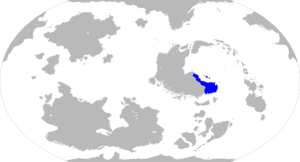
| Region |
Seforma |
|---|
Language family |
|
|---|
 |
Phonology
Consonants
|
|
Bilabial
|
Dental
|
Retroflex
|
Palatal
|
Velar
|
Pharyngeal
|
Glottal
|
| Nasal
|
m
|
n̪
|
ɳ
|
ɲ
|
ŋ
|
|
|
| Prenasalized stop
|
mp
|
n̪t̪
|
ɳʈ
|
ɲc
|
ŋk
|
|
|
| Plosive
|
p
|
t̪
|
ʈ
|
c
|
k
|
|
ʔ
|
| Trill
|
|
r̪
|
|
|
|
|
|
| Fricative
|
ɸ
|
s̪
|
ʂ
|
ç
|
x
|
ħ
|
|
| Prensalized affricate
|
mp͡ɸ
|
n̪t̪͡s
|
ɳʈ͡ʂ
|
ɲc͡ç
|
ŋk͡x
|
|
|
| Affricate
|
p͡ɸ
|
t̪͡s
|
ʈ͡ʂ
|
c͡ç
|
k͡x
|
|
|
| Approximant
|
β̞
|
|
|
j
|
|
|
|
| Prenasalized lateral affricate
|
|
n̪t̪͡ɬ
|
ɳʈ͡ɬ̢
|
ɲc͡ʎ̥
|
ŋk͡ʟ̝̊
|
|
|
| Lateral affricate
|
|
t̪͡ɬ
|
ʈ͡ɬ̢
|
c͡ʎ̥
|
k͡ʟ̝̊
|
|
|
| Lateral approximant
|
|
l̪
|
|
|
|
|
|
Prenasalized consonants are existing only between vowels as allophones of tenuis consonants.
Vowels
|
|
Front
|
Central
|
Back
|
| High
|
i
|
ɨ
|
u
|
| Mid-High
|
|
ɘ ɵ
|
|
| Mid-Low
|
ɛ
|
|
ɔ
|
| Low
|
|
ä
|
|
Phonotactics
(C)(G)V(G/ʔ)
- C = any consonant
- G = glide
- V = any vowel
- ʔ = glottal stop
Accent
Breathy voiced stress on second syllable. Monosyllabic words don't have stress.
Tones
Neutral (a), High (á), Low (à), Rising (ǎ), Falling (â). Tones have distinctive role in lexicon.
Grammar
Nouns
- split-ergative alignment: ergative-absolutive in past tenses, nominative-accusative in non-pasts.
(1. Subject = Absolutive, Agent = Nominative , Patient = Absolutive, 2. Subject = Nominative, Agent = Nominative, Patient = Accusative)
- indirective ditransitive alignment (Donor = Pegative, Recipient = Dative, Theme = Accusative)
- possessor (preffixes).
Declension
| Nominative
|
-
|
varânkà
|
jaguar
|
| Accusative
|
-sà
|
varânkàsà
|
jaguar
|
| Absolutive
|
-no
|
varânkàno
|
jaguar
|
| Pegative
|
-li
|
varânkàli
|
jaguar
|
| Dative
|
-yǒ
|
varânkàyǒ
|
for jaguar
|
| Genitive
|
-ṣy
|
varânkàṣy
|
of jaguar
|
| Ablative
|
-wâ
|
varânkàwâ
|
from jaguar
|
| Locative-Instrumental
|
-(m)pì
|
varânkàmpì
|
by/in jaguar
|
Noun class
| Human
|
Masculine
|
-râ
|
tò'râ
|
man
|
| Feminine
|
-(n)tǔ
|
tòntǔ
|
woman
|
|
|
| Non-Human
|
Strong
|
-(n)kà
|
varânkà
|
jaguar
|
| Weak
|
-(n)clí
|
là'clí
|
slow water
|
Number
| Singular
|
-
|
kǎkanankà
|
piranha
|
| Paucal
|
yè
|
kǎkanankà-yè
|
few piranhas
|
| Plural
|
má
|
kǎkanankà-má
|
piranhas
|
Possessors
|
|
Singular
|
Plural
|
| 1.
|
nè-'
|
my
|
-ànə
|
our but not your
|
| -nènce
|
our and your
|
| 2.
|
pò-
|
thy
|
ònce-
|
your
|
| oncèrø̀-
|
your and their
|
| 3.
|
ǐnə-
|
him / her / its
|
érø̀-
|
their
|
Relational nouns
[Relational noun + Locative] + [Noun + Genetive case ending]
"The dog is sleeping on top of the mat."
| ṭə̀h
|
inside
|
in
|
| ṭə́h
|
top
|
on
|
| 'ámpfø̀
|
head
|
above
|
| hùmpì
|
bottom
|
under
|
| táŋkê
|
side
|
beside
|
| klàmpá
|
distance
|
away
|
| tànclø̂
|
centre
|
between
|
| kàmpfò
|
back
|
behind, after
|
| pfǎntò
|
outside
|
out
|
| kènkle
|
wheel
|
around
|
| hýpfe
|
front
|
before, opposite to
|
| mǎntə̀
|
time
|
during, in time of
|
Verbs
- moods expressed by modal verbs.
- subject marked by independent postpositional pronoun.
- pronominal object cliticized to subjective pronoun.
Aspectual system
|
|
Unintentional
|
Intentional
|
| Incompletive
|
-
|
tèke
|
to burn (unintentionally)
|
-fú
|
tèkefú
|
to burn (intentionally)
|
| Completive
|
-vì
|
tèkevì
|
to burned (unintentionally)
|
-fûv
|
tèkefûv
|
to burned (intentionally)
|
Tense
Two groups of tense, past and non-past, are distinguished by type of morphological alignment:
- past tenses are expressed by ergative-absolutive alignment,
- non-past tenses belong to nominative-accusative alignment.
| Remote
|
adjectival participle + copular verb
|
|
to beat long ago
|
| Recent
|
-mŷ-
|
xàmpymŷ
|
to beat recently
|
| Present ~ Habitual
|
-
|
xàmpy
|
to beat
|
| Conditional
|
-(m)pfî-
|
xàmpympfî
|
would beat
|
Voice
|
|
Direct
|
Causative
|
| Active
|
-
|
tév
|
to see
|
-a-
|
téav
|
to show
|
| Reflexive
|
śì-
|
śìtév
|
to see self
|
śì- + -a-
|
śìtéav
|
to show self
|
Evidentiality
| Visual
|
-
|
klǒŋe
|
to speak (and it is visible)
|
| Non-visual
|
-(ŋ)klo
|
klǒŋeŋklo
|
to speak (and it is non-visible, but known from another source)
|
| Inferential
|
-hay
|
klǒŋehay
|
to speak (and it is non-visible and unconfirmed, renarrative action)
|
Affirmativity
| Affirmative
|
-
|
tlòmpò
|
to lie, to be situated
|
| Negative
|
áy-
|
áytlòmpò
|
not to lie
|
| Interrogative
|
ô'-
|
ô'tlòmpò
|
whether to lie ?
|
Non-finite verbs
| Action noun
|
-lê
|
vì'lê
|
drinking
|
| Participles
|
| Adjectival
|
-áśà
|
vì'áśà
|
drinking
|
| Adverbial
|
-áśû
|
vì'áśû
|
drinking
|
Adjectives
Degrees of comparison
| Positive
|
Comparative
|
Optimative
|
Superlative
|
| -
|
ŋǒ
|
pě
|
ímpě
|
| fanó
|
ŋǒ fanó
|
pě fanó
|
ímpě fanó
|
| good
|
better
|
best (of a group)
|
best (of a total)
|
Adverb
Degrees of comparison
| Positive
|
Comparative
|
Optimative
|
Superlative
|
| ø̀
|
ŋǒ ø̀
|
pě ø̀
|
ímpě ø̀
|
| ø̀ fanó
|
ŋǒ ø̀ fanó
|
pě ø̀ fanó
|
ímpě ø̀ fanó
|
| well
|
better
|
best (of a group)
|
best (of a total)
|
Numerals
Cardinal numerals
| 1.
|
kène
|
| 2.
|
ûntlì
|
| 3.
|
tolosǔ
|
| 4.
|
ôyónta
|
| 5.
|
yasónkó
|
| 6.
|
kèntopě
|
| 7.
|
tárimě
|
| 8.
|
malîmpà
|
| 9.
|
pâvayà
|
| 10.
|
sùnkây
|
| 11.
|
sùnkây kène
|
| 12.
|
sùnkây ûntlì
|
| 20.
|
ûntlì sùnkây
|
| 21.
|
ûntlì sùnkây kène
|
| 30
|
tolosǔ sùnkây
|
| 100.
|
sùnklí'
|
| 101.
|
sùnklí' kène
|
| 120.
|
sùnklí' ûntlì sùnkây
|
| 121.
|
sùnklí' ûntlì sùnkây kène
|
| 200.
|
ûntlì sùnklí'
|
| 1.000.
|
manǎká sùnklí'
|
| 10.000.
|
sùnkây manǎká sùnklí'
|
Derived numerals
|
|
Ordinal
|
Multiplicative
|
Reproductive
|
Distributive
|
Fractional
|
| aò
|
sân
|
sâná
|
alò'
|
âja
|
| 1.
|
aò kène
|
sân kène
|
sâná kène
|
alò' kène
|
âja kène
|
Pronouns
Personal pronouns
Subjectives
|
|
Singular
|
Plural
|
| 1.
|
nè'
|
I
|
ànə
|
we but not you
|
| nènce
|
we and you
|
| 2.
|
pò
|
thou
|
ònce
|
you
|
| oncèrø̀
|
you and they
|
| 3.
|
ǐnə
|
he / she / it
|
érø̀
|
they
|
Objectives
|
|
Singular
|
Plural
|
| 1.
|
nènə'
|
I
|
ànenə
|
we but not you
|
| nèncenə
|
we and you
|
| 2.
|
pònə
|
thou
|
òncenə
|
you
|
| oncèrø̀nə
|
you and they
|
| 3.
|
ǐnènə
|
he / she / it
|
érònə
|
they
|
Demonstrative pronouns
|
|
Proper
|
Distant
|
Indefinite
|
| Person / Object
|
ṭṣí
|
this
|
kxé
|
that
|
pfǔ
|
someone / something there
|
| Place
|
ṭṣíntònta
|
here
|
kxéntònta
|
there
|
pfǔntònta
|
somewhere there
|
| Source
|
ṭṣíntòntasě
|
from here
|
kxéntòntasě
|
from there
|
pfǔntòntasě
|
from somewhere there
|
| Purpose direction
|
ṭṣíntòntasê
|
to here
|
kxéntòntasê
|
to there, so far
|
pfǔntòntasê
|
to somewhere there
|
| Path
|
ṭṣíŋkêvə
|
this way
|
kxéŋkêvə
|
that way
|
pfǔŋkêvə
|
some way
|
| Time
|
ṭṣímǎntə̀
|
now
|
kxémǎntə̀
|
then
|
| Method
|
tṣíńcíntla
|
in this way
|
kxéńcíntla
|
in that way
|
pfǔńcíntla
|
in some way
|
| Quantity
|
ṭṣímpǎ
|
so much
|
| Qualify
|
ṭṣíraŋká
|
like this here
|
kxéraŋká
|
like that
|
pfǔraŋká
|
like something there
|
| Reason
|
ṭṣíṭṣàrə́
|
for this reason
|
kxéṭṣàrə́
|
for that reason
|
pfǔṭṣàrə́
|
for some reason
|
Interrogative, relative, indefinite and unlimited pronouns
|
|
Interrogative / Relative
|
Indefinite
|
Unlimited
|
| Person / Object
|
klý
|
who ? which ?
|
nỳklý
|
someone
|
sòklý
|
anyone
|
| Place
|
klýntònta
|
where ?
|
nỳklýntònta
|
somewhere
|
sòklýntònta
|
anywhere
|
| Source
|
klýntòntasě
|
whence ?
|
nỳklýntòntasě
|
from somewhere
|
sòklýntòntasě
|
from anywhere
|
| Purpose direction
|
klýntòntasê
|
whither ?
|
nỳklýntòntasê
|
to somewhere
|
sòklýntòntasê
|
to anywhere
|
| Path
|
klýŋkêvə
|
which way ?
|
nỳklýŋkêvə
|
via some way
|
sòklýŋkêvə
|
via any way
|
| Time
|
klýmǎntə̀
|
when ?
|
nỳklýmǎntə̀
|
once
|
sòklýmǎntə̀
|
ever
|
| Method
|
klýńcíntla
|
how ?
|
nỳklýńcíntla
|
somehow
|
sòklýńcíntla
|
anyhow
|
| Quantity
|
klýmpǎ
|
how much ?
|
nỳklýmpǎ
|
somehow much
|
sòklýmpǎ
|
anyhow much
|
| Quality
|
klýraŋká
|
which one ?
|
nỳklýraŋká
|
some
|
sòklýraŋká
|
any
|
| Reason
|
klýṭṣàrə́
|
why ?
|
Negative, universal and alternative pronouns
|
|
Negative
|
Universal
|
Alternative
|
| Person / Object
|
máklý
|
nobody, nothing
|
vámaklý
|
every
|
pîsòklý
|
anyone else
|
| Place
|
mántònta
|
nowhere
|
vámantònta
|
everywhere
|
pîsòntònta
|
elswhere
|
| Source
|
mántòntasě
|
from nowhere
|
vámantòntasě
|
from everywhere
|
pîsòntòntasě
|
from elswhere
|
| Purpose direction
|
mántòntasê
|
to nowhere
|
vámantòntasê
|
to everywhere
|
pîsòntòntasê
|
to elswhere
|
| Path
|
máŋkêvə
|
through no way
|
vámaŋkêvə
|
through all ways
|
pîsòŋkêvə
|
which way else
|
| Time
|
mámǎntə̀
|
never
|
vámamǎntə̀
|
always
|
pîsòmǎntə̀
|
when else
|
| Method
|
máńcíntla
|
nohow
|
vámańcíntla
|
in all methods
|
pîsòńcíntla
|
otherwise
|
| Quantity
|
mámpǎ
|
nothing
|
pîsòmpǎ
|
otherwise than so many
|
| Quality
|
máraŋká
|
neuter, indistinct
|
vámaraŋká
|
any
|
pîsòraŋká
|
other
|
Numeral pronouns
| Interrogative / Relative
|
klýmpǎ
|
how much ?
|
| Indefinite
|
nỳklýmpǎ
|
write a number
|
| Unlimited
|
sòklýmpǎ
|
however many
|
| Negative
|
mámpǎ
|
nothing
|
| Alternative
|
pîsòmpǎ
|
otherwise than so many
|
Reflexive-reciprocal and cooperative pronouns
| Reflexive / Reciprocal
|
sî
|
oneself / each other
|
| Cooperative
|
jèsî
|
together cooperatively
|
Postpositions
| Companion, attributive object
|
là'
|
with
|
Instrumental
|
| Originative direction
|
sě
|
from
|
Genetive
|
| Destinative direction, purpose, goal
|
sê
|
to
|
Genetive
|
| Lack
|
lǎ'
|
without
|
Genetive
|
| Alternative
|
'ancla
|
instead
|
Genetive
|
| Contrary
|
ṭlàlà
|
against
|
Dative
|
| Resistance
|
tsárahè
|
despite, though
|
Dative
|
| Stylization
|
tsáŋkarì
|
along to, according to
|
Dative
|
| Benefactive
|
safâ
|
for, destined to
|
Dative
|
| Essive
|
yê
|
as, at character of
|
Absolutive
|
Particles
Conjunctions
| Paratactical conjunctions
|
| Copulative
|
tsa
|
and
|
| Conjunctive
|
tsahì
|
also
|
| Disjunctive
|
tó
|
or
|
| Contrastive, exceptional
|
tô
|
but
|
| Consequentive
|
kêre
|
so
|
| Comparative
|
tóre
|
than
|
|
|
| Hypotactical conjunctions
|
| ŋèlé
|
to, for
|
| mòŋa'ê
|
althought
|
| tòntlê
|
because
|
| kêntò
|
if
|
| sá
|
that, providing
|
Modifiers
| Restrictive
|
ø̀ kène
|
only
|
| Additive
|
ø̀ tlô
|
yet
|
Polarity particles
| Affirmative
|
pfà
|
yes
|
| Negative
|
ná
|
no
|
Word formation
Compounding
Derivation
Noun
Noun to noun
| Diminutive
|
ńíńí
|
cçájúli → cçájúli ńíńí
|
daughter → little daughter
|
| Augmentative
|
kampâ
|
tâmpùrù → tâmpùrù kampâ
|
mountain → grand mountain
|
| Contradiction
|
má
|
tò'râ → má tò'râ
|
human → non-human
|
| Similarity
|
ká'èṇṭe
|
tàntà → tàntà ká'èṇṭe
|
tree → pseudo-tree
|
| Half
|
tè'òt
|
súŋkú → súŋkú tè'òt
|
dog → half-dog
|
| Relational abstract
|
-sâsə
|
màŋky̌ → màŋky̌sâsə
|
brother → brotherhood
|
| Related person
|
-áśà
|
mǔmáŋky → mǔmáŋky'áśà
|
cow → cowman
|
| Collective
|
-tâ
|
çáŋkalà → çáŋkalàtâ
|
bird → birds (a a collective)
|
| Place
|
-ntòntahì
|
'àmpâ → àmpântòntahì
|
fire → campfire
|
| Art / Craft
|
'ø̀ŋkxáj
|
vǎjpǔ → 'ø̀ŋkxáj vǎjpǔṣy
|
war → craft of war
|
| Knowledge
|
tə̂jmà
|
sûńcerè → tə̂jmà sûńcerèṣy
|
herb → herbalism
|
| Expert
|
tə̂jmà'áśà
|
sûńcerè → tə̂jmà'áśà sûńcerèṣy
|
herb → herbalist
|
Noun to adjective
| Possessive
|
-la
|
tò'râ → tò'râla
|
man → human
|
| Originative
|
-sě
|
táŋàŋka → táŋàŋkasě
|
sky → celestial
|
| Similaritive
|
ká'èṇṭe ...-la
|
mø̀lø̀ŋka → ká'èṇṭe mø̀lø̀ŋkala
|
cat → felid
|
| Feature
|
-la
|
śílà → śílàla
|
hair → hairy
|
| Affiliative
|
-la
|
kxè'ûntə → kxè'ûntəla
|
family → familiar
|
| Privative
|
ma-...-la
|
kòntla → kòntlala
|
tooth → toothless
|
Verb
Verb to noun
| Agentive
|
-áśà
|
'àts- → 'àtsáśà
|
(to) shoot → shooter
|
| Experiencer, adressee
|
-áśà-sî
|
têŋk- → têŋkáśàsî
|
(to) teach → learner
|
| Result
|
-jə̂
|
tàmpø- → tàmpøjə̂
|
(to) fall → (a) fall
|
| Instance
|
-jáj'
|
klǒŋe- → klǒŋejáj
|
(to) speak → speech
|
| Instrument
|
-tète
|
xàmp- → xàmptète
|
(to) beat → whip
|
| Place
|
-ntòntahì
|
tumu- → tumuntòntahì
|
(to) kill → slaughterhouse
|
Verb to verb
Adjective
Adjective to noun
| Abstract
|
-sâsə
|
sùmpfù → sùmpfùsâsə
|
strong → strength
|
Adjective to adjective
| Tendency
|
-jǎla
|
çémě → çémějǎla
|
good → bland
|
| Intensification
|
-sùmpfù-la
|
pâṇṭá → pâṇṭásùmpfùla
|
big → very big
|
| Excess
|
-vâhø-la
|
ńíńí → ńíńívâhøla
|
small → too small
|
Syntax
Word order
Modal verbs
| Energetic
|
vèṇṭṣá
|
to be sure of
|
| Conditional
|
kóvla
|
would be
|
| Potentional
|
ṇâṇ
|
to may
|
| Eventive
|
ṇóŋkə̀
|
would may
|
| Jussive
|
ṣèŋkxà
|
to should
|
| Precative
|
palí
|
to please, to request
|
| Necessitative
|
kxàŋà
|
to must
|
| Permissive
|
tóntsô
|
to allow
|
| Desiderative
|
jø̀ńcçé
|
to want
|
Copular verbs
| Translative
|
tsáts
|
became
|
| Essive
|
tlò
|
be
|
See Also


